
How to Go from Blonde to Dark Hair with Organic Botanical Hair Colour
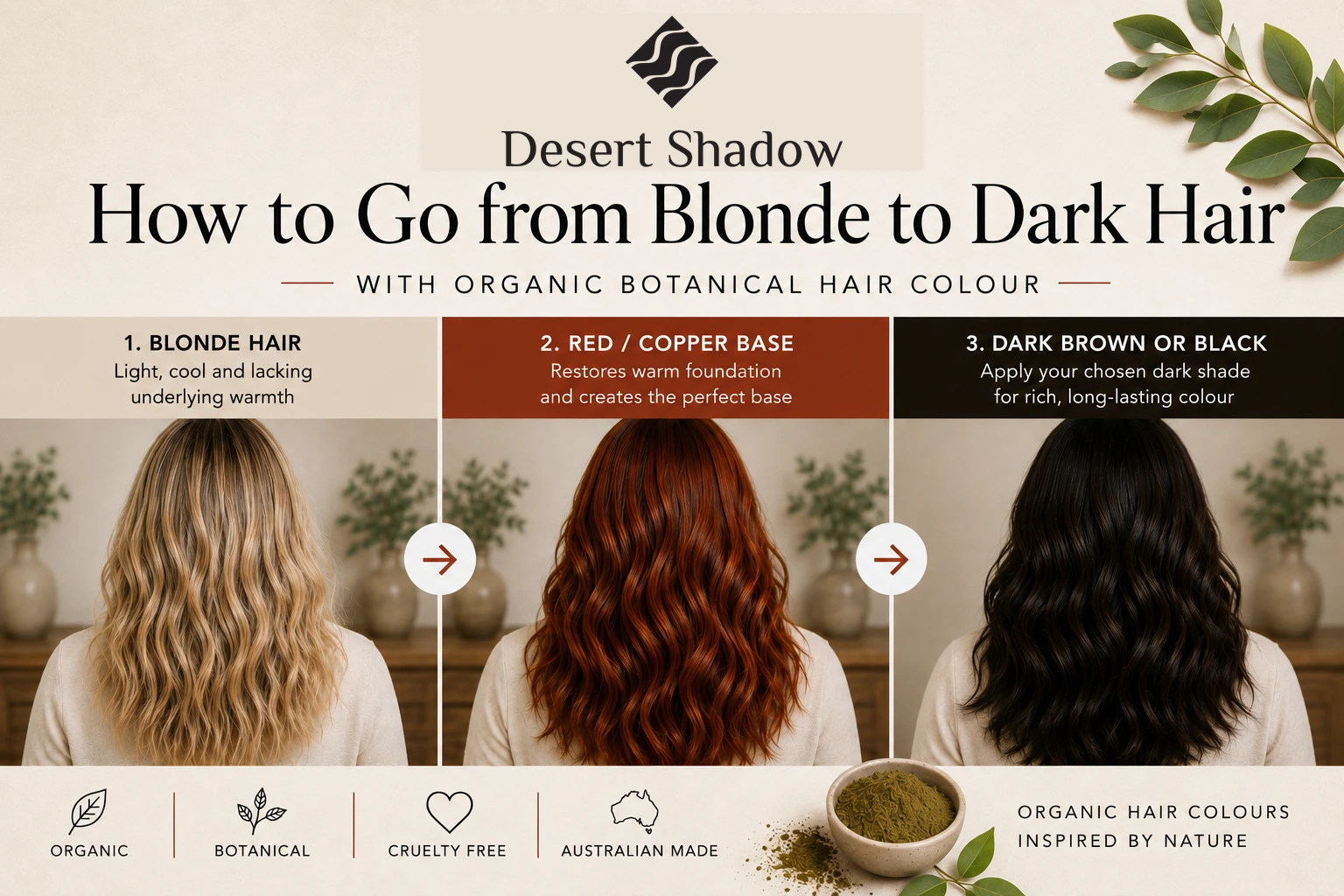
Going from blonde to dark hair with organic botanical hair colour is absolutely possible, but when you're making a significant colour change, creating the right foundation is important.
If your hair is naturally blonde, bleached, highlighted, balayaged or significantly lightened and you want to use one of our darkest Desert Shadow Organic Hair Colours, you'll first need to restore the warm pigments that naturally occur in darker hair.
At Desert Shadow, we call this creating a Red Base.
The process involves applying Red Shadow or Copper Shadow first, followed by your chosen darker colour.
In this guide, we'll explain why a Red Base is important, how the process differs for naturally blonde and chemically lightened hair, and how to move from blonde to dark brown or blue-black using Desert Shadow Organic Hair Colours.
Which Desert Shadow Colours Need a Red Base on Blonde Hair?
If you have blonde, very light, bleached or significantly lightened hair and want to use:
-
Chocolate Shadow — Dark Brown
-
Deep Chestnut Shadow — Darkest Brown
-
Indigo Shadow — Blue Black
you'll need to apply either Red Shadow or Copper Shadow first.
The warm red and copper botanical pigments create the foundation needed for the darker colour that follows.
Why Does Blonde Hair Need a Red Base Before Going Dark?
Naturally darker hair contains underlying warm pigments.
When hair is naturally very light, or when those pigments have been removed through bleaching or significant chemical lightening, that warm foundation is missing.
When moving from blonde to a very dark organic botanical hair colour, we need to put some of that warmth back into the hair first.
Applying Chocolate Shadow, Deep Chestnut Shadow or Indigo Shadow directly to very light hair without creating the correct foundation may result in colour that appears uneven, dull, ashy, blue or green.
Applying Red Shadow or Copper Shadow first restores the warm foundation that helps the darker botanical pigments develop into a richer, more balanced colour.
Don't be alarmed by how your hair looks after the first step. Blonde hair can look very copper or red after the Red Base application.
That's exactly what we want.
It isn't your finished colour. The darker Desert Shadow colour is applied over this foundation in the second step.
Naturally Blonde Hair vs Bleached Blonde Hair
One of the most important things to understand is why your hair is blonde.
The application method can be different for naturally blonde hair and hair that has been chemically lightened.
Naturally Blonde or Very Light Hair
If your natural hair colour is blonde or very light and you want to colour your hair with Chocolate Shadow, Deep Chestnut Shadow or Indigo Shadow, your light hair needs a Red or Copper foundation first.
As your natural blonde regrowth appears, the new light regrowth will also need the Red Base before your darker Desert Shadow colour is applied.
This is because every new section of blonde hair begins without the underlying warm pigment needed to support the darker colour.
Bleached, Highlighted or Balayaged Hair
If your natural hair is darker but your lengths, highlights or balayage have been bleached or significantly lightened, concentrate the Red or Copper base on the lightened areas.
Your naturally darker regrowth generally doesn't need the same Red Base.
Previously lightened areas may need the Red Base for the first and possibly second dark-colour application while sufficient botanical pigment builds through the hair.
Once the colour has established itself through those areas, you may no longer need to repeat the Red Base there.
Every head of hair is different, so use your previous result and a strand test to guide future applications.
What If I Have Both Grey Hair and Bleached Hair?
Treat the different areas according to their starting colour.
Bleached or very light sections need the warm Red/Copper foundation before Chocolate Shadow, Deep Chestnut Shadow or Indigo Shadow.
Grey hair is different.
Having a high percentage of grey does not automatically mean you need a Red Base before Chocolate Shadow or Deep Chestnut Shadow.
Some grey hair accepts Desert Shadow Organic Hair Colour readily, while other grey can be more resistant.
For grey hair, begin with our recommended grey-coverage method. If your grey proves resistant, additional preparation may be required.
Indigo Shadow is the exception. A Red or Copper base is required when using Indigo Shadow on grey hair.
Red Shadow or Copper Shadow — Which Should I Choose?
Either can be used to create the warm foundation.
Copper Shadow — 7.4 Hot Copper Red
Creates a bright copper-red foundation.
Red Shadow — 6.4 Medium Copper Red
Creates a deeper medium copper-red foundation.
Both provide the warm botanical pigments needed before applying Chocolate Shadow, Deep Chestnut Shadow or Indigo Shadow to blonde or significantly lightened hair.
Remember, you're not choosing your final hair colour at this stage.
The purpose of the Red or Copper Shadow is to create the foundation underneath your finished dark colour.
What You'll Need
Before you start, have everything ready:
-
Red Shadow or Copper Shadow
-
Chocolate Shadow, Deep Chestnut Shadow or Indigo Shadow
-
gloves
-
mixing bowl
-
tinting brush
-
comb
-
shower cap or suitable hair wrap
-
old towel or protective covering
Read the instructions supplied with both Desert Shadow Organic Hair Colours before beginning.
We also strongly recommend performing a strand test before making a significant colour change.
Step 1 — Create Your Red Base
Mix your Red Shadow or Copper Shadow according to the instructions supplied with the colour.
These shades have a relatively short activation time and can be used soon after mixing.
Apply the Red Base
Apply generously to the blonde, bleached or significantly lightened areas that need the warm foundation.
If all of your hair is naturally blonde or very light and you're moving to a dark colour, apply the Red Base to all areas that will receive the darker colour.
If only sections of your hair are bleached, highlighted or balayaged, concentrate the Red Base on those lightened areas.
Make sure the hair is thoroughly coated.
Cover your hair with a shower cap or suitable wrap to help retain moisture and allow the Red or Copper base to process for approximately 1–2 hours.
Step 2 — Rinse the Red Base
Once processing is complete, rinse the Red or Copper base thoroughly according to the instructions supplied with your colour.
Towel dry your hair in preparation for the second colour application.
At this point, your blonde or bleached hair may look extremely copper or red.
Don't panic.
This is the foundation colour, not your finished result.
The dark colour applied in the next step will sit over this warm botanical foundation.
When Should I Apply the Dark Colour?
You can apply your Chocolate Shadow, Deep Chestnut Shadow or Indigo Shadow:
-
immediately after your Red/Copper base, or
-
within approximately 24–48 hours
Make sure all areas that received the Red Base are covered by your final dark colour.
Step 3 — Apply Your Dark Desert Shadow Colour
Mix your chosen Desert Shadow Organic Hair Colour according to the instructions supplied with the product.
Important mixing instruction
After creating the Red/Copper base, use the NON GREY COVERAGE mixing method for the second colour application.
Apply your Chocolate Shadow, Deep Chestnut Shadow or Indigo Shadow generously, making sure you completely cover the areas where the Red or Copper base was applied.
Depending on your starting colour and what you're maintaining, you may apply the final colour to:
-
your entire head
-
your regrowth
-
previously lightened sections
-
or the specific areas requiring colour
Once applied, cover your hair with a shower cap or suitable wrap to retain moisture.
Allow your chosen Desert Shadow Organic Hair Colour to process according to its individual instructions.
Depending on the shade and application, this may be approximately 2–4 hours.
Always follow the instructions supplied with your individual colour.
Step 4 — Rinse and Allow Your Colour to Develop
Once processing is complete, rinse according to the instructions for your chosen Desert Shadow colour.
Remember that organic botanical hair colour continues to develop after rinsing.
Allow approximately 72 hours before judging your final colour.
During this time, the botanical pigments continue to oxidise and the colour may deepen and become more balanced.
Do I Need a Red Base Every Time?
It depends on your natural hair colour and why the hair is light.
Naturally blonde hair
If your natural regrowth is blonde or very light, the new light regrowth will need a Red or Copper base before Chocolate Shadow, Deep Chestnut Shadow or Indigo Shadow.
Naturally dark hair with bleached lengths
If your natural regrowth is already dark, you generally only need the Red Base on the bleached or significantly lightened areas.
These areas may require a Red Base for the first and possibly second application while the organic botanical colour builds.
Grey hair
Grey hair does not automatically require a Red Base before Chocolate Shadow or Deep Chestnut Shadow simply because there is a high percentage of grey.
If your grey is resistant, follow our dedicated grey-coverage and resistant-grey guidance.
A Red/Copper base is always required before Indigo Shadow on grey hair.
Can I Go Dark After Balayage?
Yes.
If your balayage has created blonde or significantly lightened sections through otherwise darker hair, those lightened areas need their warm foundation restored before applying Chocolate Shadow, Deep Chestnut Shadow or Indigo Shadow.
Apply your Red Shadow or Copper Shadow to the lightened sections.
If your natural regrowth remains dark, it generally doesn't need the Red Base.
This allows you to replace the missing warm pigment specifically where the hair has been lightened rather than unnecessarily applying the Red Base to naturally darker hair.
What About Highlights?
The same principle applies to highlighted hair.
If your highlights are blonde or significantly lighter than your natural hair and you're moving to Chocolate Shadow, Deep Chestnut Shadow or Indigo Shadow, apply the Red/Copper foundation to the lightened strands.
If there are many fine highlights throughout the hair and separating them isn't practical, contact the Desert Shadow team for guidance before colouring.
A clear photograph in natural daylight can help us understand your starting colour and recommend the most suitable approach.
What If My Blonde Hair Is Chemically Damaged?
Bleached and chemically lightened hair can be more porous than untreated hair.
This means it may absorb organic botanical hair colour differently from your natural hair.
If your hair is very dry, damaged or highly porous, strand testing is particularly important before making a full colour change.
A strand test allows you to see:
-
how strongly the Red/Copper base takes
-
how your chosen dark colour develops
-
whether the lightened sections colour evenly
-
how porous areas respond
-
how your hair responds to the complete two-step process
If you're concerned about the condition of your hair or have experienced significant chemical damage, seek appropriate professional advice before further colouring.
Always Strand Test Before Going from Blonde to Dark
Moving from very light hair to dark brown, darkest brown or blue-black is a significant colour change.
We strongly recommend a strand test before committing to the full application.
Importantly, test the complete two-step process:
Red Shadow or Copper Shadow → your chosen dark Desert Shadow Organic Hair Colour
Testing only Chocolate, Deep Chestnut or Indigo directly on blonde hair won't show you the finished result of the method you'll actually be using.
A strand test also allows you to see how your individual hair responds to botanical pigments before colouring your entire head.
What About Leftover Colour?
If you regularly use less than a full pack, it's better to divide the dry product before activation rather than mixing more than you need.
Red Shadow and Copper Shadow
Follow the storage instructions supplied with your colour.
Where appropriate, activated Red or Copper colour can be frozen for later use.
Chocolate Shadow, Deep Chestnut Shadow and Indigo Shadow
Once these colours have been fully mixed and activated, don't save the mixed colour for a future application.
If you need less than a full pack, divide the dry components proportionally before activation according to the mixing instructions.
Can Organic Hair Colour Lighten Dark Hair?
No.
Desert Shadow Organic Hair Colours contain no bleach or peroxide and cannot lighten your existing hair colour.
They work by depositing botanical pigments onto the hair rather than removing your natural pigment.
This is why going from blonde to dark is possible: we're adding colour and depth to the hair.
Going from a dark Desert Shadow colour back to blonde is very different because the botanical pigments would need to be removed or significantly lightened.
Think carefully before choosing a dramatically darker colour if you expect to want blonde hair again soon.
Can I Bleach My Hair After Using Organic Botanical Hair Colour?
If you think you may want to bleach or significantly lighten your hair in the future, discuss your previous botanical colour use with an experienced hairdresser before proceeding.
This is particularly important if you've used darker botanical colours or products containing indigo.
Always tell your hairdresser exactly which Desert Shadow Organic Hair Colours you've used and approximately when they were applied.
How Long Does Organic Botanical Hair Colour Last?
Desert Shadow Organic Hair Colours are designed to create lasting botanical colour.
How your colour develops and fades will depend on your starting hair, porosity, shade, washing routine and number of applications.
Botanical pigments also build with repeated applications.
Once you've achieved the depth and tone you like through your lengths, concentrate future applications primarily on your regrowth and refresh the lengths periodically as needed.
This helps prevent unnecessary colour build-up through the ends.
Choosing Your Final Dark Colour
If you're deciding between our darker shades:
Chocolate Shadow
A rich, classic dark brown.
Deep Chestnut Shadow
Our deepest brown, with subtle warm-red reflects.
Indigo Shadow
Our darkest option, creating blue-black tones.
Remember that Desert Shadow cannot lighten your hair later, so if you're uncertain between two depths, consider the lighter option first.
You can build additional depth with future applications.
Need Help Going from Blonde to Dark?
Going from blonde to dark with organic botanical hair colour is a significant change, and you don't have to work it out alone.
If you're unsure which Desert Shadow colour or Red Base method is right for your hair, send the Desert Shadow team:
-
a clear photograph of your hair in natural daylight
-
your natural hair colour
-
your current hair colour
-
whether your blonde is natural, bleached, highlighted or balayaged
-
your approximate percentage of grey, if applicable
-
details of previous chemical, henna, indigo or botanical hair colour
-
the final colour you'd like to achieve
We'll help guide you towards the most appropriate Desert Shadow Organic Hair Colour and application method for your hair.
Related Desert Shadow Guides
For more detailed information, read:
These guides will help you understand colour selection, grey coverage, preparation and the correct application method for your hair.