
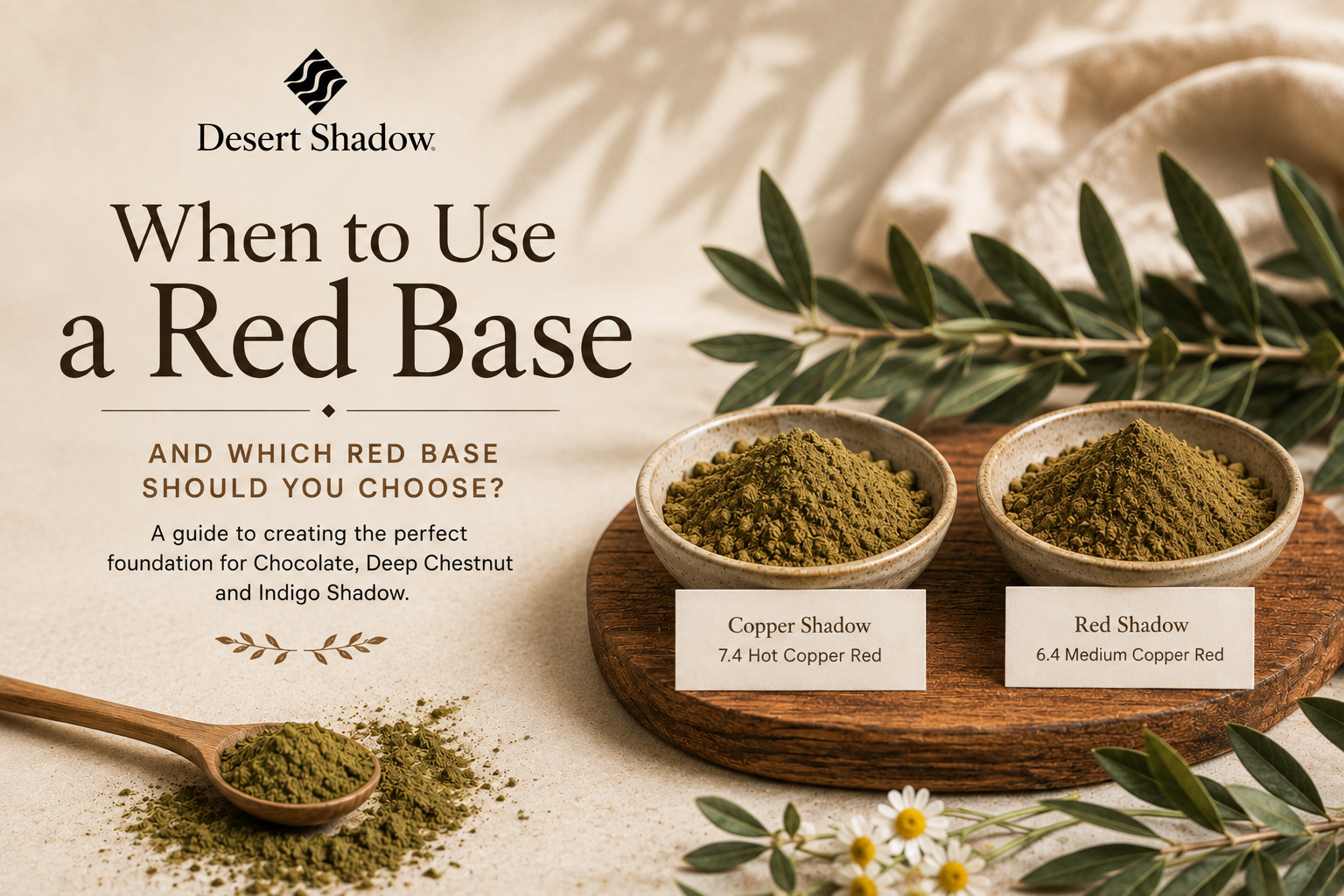
When to Use a Red Base
And which Desert Shadow red base should you choose?
If you're moving from light hair to one of our darkest shades—or you're having difficulty getting a rich result on stubborn grey—you may need to use a Red Shadow or Copper Shadow base first.
The red base creates the warm foundation needed for our darker botanical colours to develop correctly.
But not everyone with grey hair needs one.
Here's how to know when a red base is required, when it may help, and when you don't need one at all.
What is a red base?
A red base is an application of Red Shadow or Copper Shadow before applying one of our darker shades:
-
Chocolate Shadow
-
Deep Chestnut Shadow
-
Indigo Shadow
The warm red/copper pigments create a foundation for the darker botanical colour.
This is particularly important when taking very light hair to a much darker shade.
Which red shade should I use?
You can use either:
Copper Shadow — 7.4 Hot Copper Red
or
Red Shadow — 6.4 Medium Copper Red
Both provide the warm foundation needed before applying the darker colour.
You don't need to match the red base to your final colour—the red is acting as a foundation and will be covered by the darker shade.
When is a red base required?
Blonde or very light hair going dark
If your hair is naturally blonde, very light, bleached or significantly lightened and you want to use:
-
Chocolate Shadow
-
Deep Chestnut Shadow
-
Indigo Shadow
you will need to apply a Red Shadow or Copper Shadow base first.
When moving from very light hair to a dark botanical colour, the hair needs warm pigment underneath the darker shade.
Without this warm foundation, the final colour may appear uneven or develop unwanted blue, green or ashy tones.
Indigo Shadow on grey hair
A red base is always required when applying Indigo Shadow to grey hair.
Grey hair has little or no natural pigment to provide the warm foundation Indigo needs.
Applying Indigo directly to grey or very light hair can result in unwanted blue, green or ashy tones.
Always use Red Shadow or Copper Shadow first when using Indigo on grey hair.
When might a red base help?
Stubborn or colour-resistant grey
Having a high percentage of grey does not automatically mean you need a red base.
Some grey hair accepts Desert Shadow colour beautifully using our standard grey-coverage method, while other grey can be more resistant.
If you are using Chocolate Shadow or Deep Chestnut Shadow, begin with the standard grey-coverage preparation and mixing instructions.
If your grey doesn't take the colour sufficiently, use the Pre Colour Wash Bar or Peachie Clean Shampoo Bar immediately before colouring to help remove oils and build-up that may interfere with colour uptake.
If your grey remains stubborn or resistant after following the recommended preparation, a Red Shadow or Copper Shadow base can provide a stronger foundation before applying Chocolate or Deep Chestnut.
The important distinction is:
Lots of grey doesn't necessarily mean resistant grey.
A person with 80% grey that accepts colour easily may not need a red base for Chocolate or Deep Chestnut, while someone with 30% very resistant grey may benefit from one.
When should I NOT use a red base?
Do not automatically use a red base simply because you have grey hair.
A red base is specifically used with our darker shades—Chocolate Shadow, Deep Chestnut Shadow and Indigo Shadow—when the starting colour or resistance of the hair requires it.
You do not need a red base before our other Desert Shadow shades unless specifically advised by the Desert Shadow team.
What happens if I don't use a red base on blonde or very light hair?
If you apply Chocolate, Deep Chestnut or Indigo directly over blonde, bleached or very light hair without first establishing a warm foundation, the result may appear washed out, uneven, ashy, blue or green.
This happens because the light hair doesn't contain enough underlying warm pigment to support the darker botanical colour.
Using Red Shadow or Copper Shadow first creates that foundation.
What if only part of my hair is blonde or bleached?
If your natural regrowth is dark but your lengths or ends have been bleached, balayaged or significantly lightened, you only need to apply the red base to the lightened areas.
For previously bleached lengths, you may need the red base for the first one or two dark-colour applications while the botanical colour builds.
Once sufficient colour has built through those areas, you may no longer need to repeat the red base there.
If your natural regrowth itself is blonde or very light, the new light regrowth will need the red base whenever you apply Chocolate, Deep Chestnut or Indigo.
How to apply your red base
Step 1 — Apply Red Shadow or Copper Shadow
Mix your chosen Red Shadow or Copper Shadow according to the instructions supplied with the product.
Apply generously to the areas that require the red base.
Cover your hair with a shower cap or suitable wrap and leave the red base to process for approximately 1–2 hours.
Rinse thoroughly according to the product instructions and towel dry your hair.
Don't worry if your light or grey hair looks very copper or red at this stage. This colour is creating the foundation for the darker shade that follows.
Step 2 — Apply your darker colour
You can apply your:
-
Chocolate Shadow
-
Deep Chestnut Shadow
-
Indigo Shadow
after the red-base application.
This can be done immediately or within approximately 24–48 hours.
Apply the darker colour to all areas where the red base was used and follow the mixing, application and processing instructions for your chosen Desert Shadow colour.
What if my grey is resistant?
If you're using Chocolate or Deep Chestnut and your grey isn't taking the colour well, don't immediately assume you need to change shades.
First check that:
-
your hair is clean and free from oils and product build-up
-
you're following the grey-coverage mixing instructions
-
the grey is thoroughly coated
-
the paste remains moist while processing
-
you're allowing the recommended processing time
If your grey remains resistant, use the Pre Colour Wash Bar or Peachie Clean Shampoo Bar before colouring.
If you're still not achieving sufficient depth, a Red Shadow or Copper Shadow base may be the next step.
For Indigo Shadow on grey hair, however, the red base is always required.
Do I need a red base every time?
It depends on your starting hair and the colour you're using.
Naturally blonde or very light regrowth:
If you're maintaining Chocolate, Deep Chestnut or Indigo, the new light regrowth will need a red base before the darker colour.
Bleached or lightened lengths with naturally darker regrowth:
You may only need to red-base the lightened sections for the first one or two applications while the darker botanical colour builds.
Stubborn grey with Chocolate or Deep Chestnut:
Whether you continue using a red base depends on how your individual hair responds and the depth of colour you're trying to maintain.
Grey hair with Indigo:
A red base is required before Indigo.
Always strand test
Botanical colour is individual.
Your starting colour, percentage of grey, hair porosity, previous colouring and the way your hair accepts plant pigment can all influence your result.
Always perform a strand test before making a significant colour change or using a new application method.
Still unsure whether you need a red base?
We're happy to help.
Send the Desert Shadow team:
-
a clear photo of your hair in natural daylight
-
your natural hair colour
-
your current hair colour
-
approximate percentage of grey
-
details of any previous chemical, henna, indigo or botanical colour
-
which Desert Shadow shade you'd like to use
-
whether you've previously had difficulty getting colour to take on your grey
We can then help determine whether you should start with the standard grey-coverage method, use additional preparation for resistant grey, or apply a Red or Copper base before your darker Desert Shadow colour.